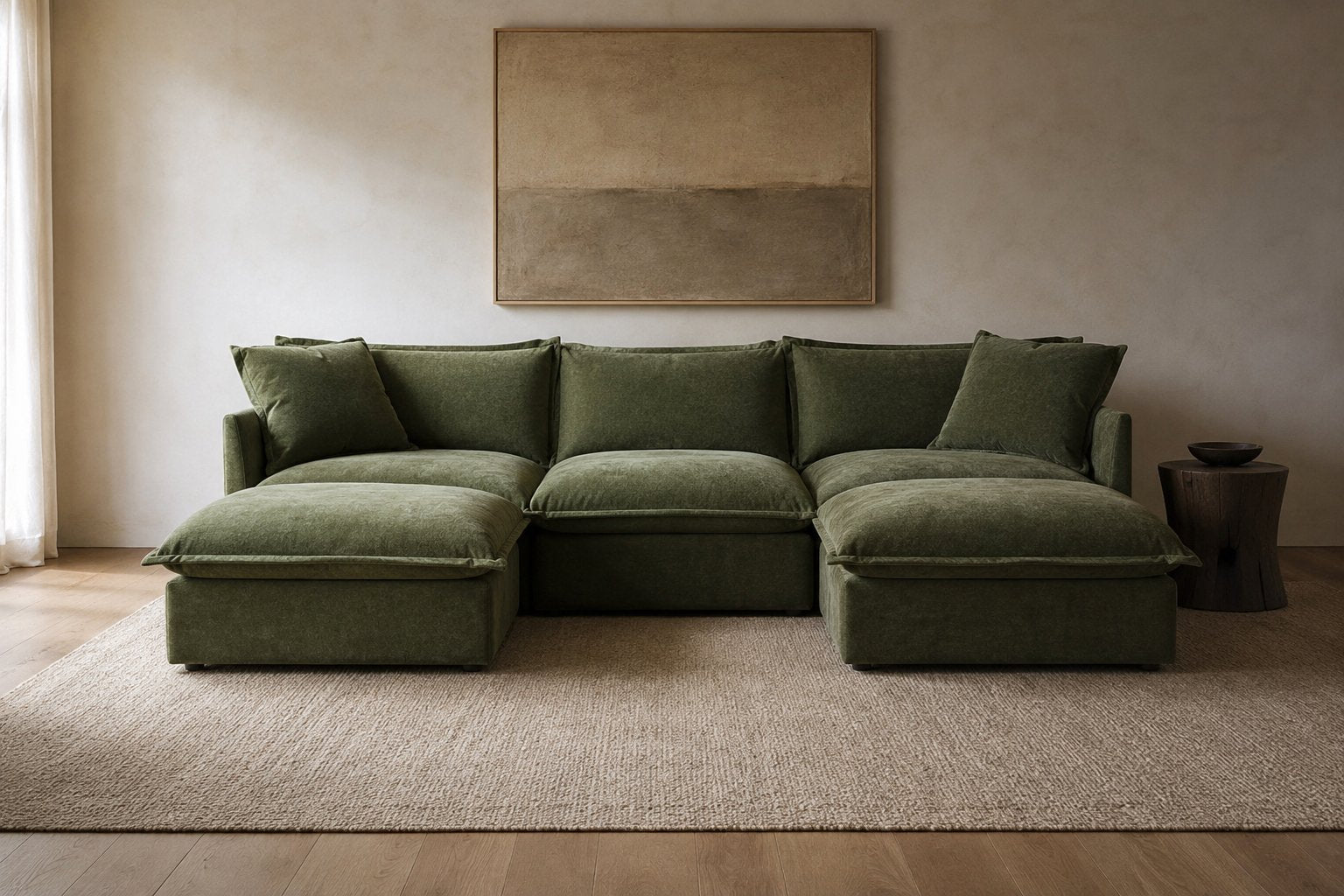

What Is the Difference Between a Couch and a Sofa?
There is no meaningful difference. "Couch" and "sofa" describe the same piece of furniture, and in the American furniture trade the two words are used interchangeably. They simply reached English by different routes: "couch" from the Old French couche, built on a verb meaning to lie down, and "sofa" from the Arabic suffah, a raised bench spread with cushions, which came into English through Turkish. The distinctions people repeat, that a sofa is formal and a couch is casual, or that a sofa has arms and a couch does not, are style conventions rather than rules, and no manufacturer, retailer or standards body enforces them. What does change the piece you end up living with is seat count, overall width, seat depth and seat height. Those are numbers, and they are published in the specifications on each listing.
Where the two words came from
"Couch" entered Middle English from the Old French noun couche, which came from a verb meaning to lie down. Early on it meant furniture you reclined on rather than sat upright on. "Sofa" is a later arrival, from Turkish, drawn from the Arabic suffah, meaning a ledge or bench. Both "sofa" and "settee" came into general English use in the early 18th century.
Regional habit explains most of the heat in this question. "Couch" is the common word in North America, Australia, Ireland and South Africa. "Sofa" and "settee" dominate in the United Kingdom and India. In Canada, "chesterfield" has long been used for any upholstered seat of this kind, though that usage is fading. "Settee" once meant a smaller sofa, but that distinction had collapsed by the 20th century, and today the word is just another synonym.
So when a listing says couch and the one next to it says sofa, you are looking at two writers' habits, not two categories of furniture.
What this catalogue shows
At Two Seventy Nine, pieces titled "couch" and pieces titled "sofa" share the same product type and sit together in the same Couches collection. There is no separate sofa department, because there is nothing to separate. The specifications make the point better than the words do.
| Piece | Width | Depth | Height | Seats |
|---|---|---|---|---|
| White 3-Seat Couch | 79 in | 31 in | 34 in | 3 |
| Camel Boucle 3-Seat Curved Sofa | 78.9 in | 35.4 in | 27.2 in | 3 |
| Boucle 3-Seat Couch | 72 in | 33.5 in | 31.5 in | 3 |
| Green Boucle Loveseat | 74.4 in | 31.3 in | 29.9 in | 2 |
Read the first two rows. One is called a couch and one is called a sofa, they are within a tenth of an inch of each other in width, and they seat the same number of people. The real gap between them is 4.4 inches of depth and nearly 7 inches of height, which you would never guess from the names.
Now read the last two rows. The loveseat is a two-seater, and it is 2.4 inches wider than the three-seat couch above it. If you had shopped by the word alone you would have ordered the wrong thing.
The labels that do carry real information
Some furniture words are genuinely useful, because they describe structure or seat count rather than register.
- Loveseat. Two seats. This is a count, not a size. Among the loveseats here, one runs 74.4 inches wide and another 50 inches wide, and both are two-seaters.
- Sofa or couch. Conventionally three or more seats in a single straight or curved frame.
- Sectional. Separate sections that join into an L or a U. A sectional changes your floor plan, not just your seating. One L-shaped sleeper sectional here measures 118 in wide by 86.6 in deep, seats six, and weighs 250.4 lbs.
- Modular. Sections you can rearrange yourself. One modular sectional in this catalogue is titled a couch, measures 104 in wide by 68.9 in deep, seats four, and needs no assembly.
- Sleeper. A frame or cushion stack that opens into a bed. The sleeping surface is a separate published measurement. On that L-shaped sleeper sectional it is 79 in wide by 104.7 in long.
Those words tell you something. "Couch" versus "sofa" does not.
The four numbers to check instead of the word
If you want to know what a piece will feel like and whether it will fit, these are the figures that decide it.
- Overall width. Sets the wall it can live on and whether it clears your doorways.
- Overall depth. Decides how far it reaches into the room and how much walkway you have left. Among the four pieces in the table above, depth ranges from 31 in to 35.4 in, a four-inch swing on seating that all looks similar in a photograph.
- Seat height. Floor to the top of the seat cushion. This is what your knees notice. The Green Boucle Loveseat publishes a seat height of 18.1 in; the L-shaped sleeper sectional publishes 17.8 in.
- Seat depth. Front edge of the seat to the base of the backrest. This is what decides whether you sit upright or sink back. That same loveseat publishes 23.1 in.
Seat height and seat depth are published in the specifications on each listing where the manufacturer supplies them. Overall width, depth and height are published across the board. When a listing also gives arm height, cushion fill or foam density, those are worth a look too: the Green Boucle Loveseat lists pocket springs with foam, a foam density of 1.8 lbs per cubic foot, square arms and a solid pine frame, and the sleeper sectional lists an arm height of 26 in from the floor.
Construction, stated plainly
Upholstered seating is usually a wood frame, a suspension layer, and foam or fiber on top, wrapped in fabric. Frames in this catalogue are described per listing: rubber wood with plywood panels on the White 3-Seat Couch, solid pine on the Green Boucle Loveseat, iron with plywood on the L-shaped sleeper sectional. Engineered panels such as plywood or MDF are normal in this part of the market and appear alongside solid timber in many frames. The useful question is not which word the listing uses for the piece, but what the frame is made of, how the seat is supported, and what the thing weighs. Weight is a decent proxy for how much material is in it: the four pieces in the table above run from 89.6 lbs to 105.8 lbs, and that sleeper sectional is 250.4 lbs.
How to measure before you order
Take the published overall width, depth and height, then walk the route the piece has to travel. Measure your narrowest doorway, the diagonal of any turn in a hallway or stairwell, and the elevator car if you are in an apartment. A piece that fits the wall but not the turn is the most common avoidable mistake.
Then mark the footprint on your floor with tape before you commit. Leave at least 30 to 36 inches for a main walkway, and check what the depth figure does to that number.
Outbound shipping is free on these pieces. Returns are accepted within 30 days, and return shipping is the customer's cost, which is a good reason to measure first rather than order two sizes and send one back.
Frequently asked questions
Is a couch the same thing as a sofa?
Yes. In everyday American use and in the furniture trade the two words mean the same piece of furniture and are used interchangeably. The difference is regional and historical, not structural. No specification, warranty or standard treats a couch and a sofa differently.
Is a loveseat just a small sofa?
A loveseat is defined by seat count, not size: it has two seats. That usually makes it narrower than a three-seater, but not always. In this catalogue a loveseat measuring 74.4 in wide sits alongside a three-seat couch measuring 72 in wide, so the two-seater is the wider piece. Always compare the published width rather than relying on the label.
Does "couch" mean something cheaper than "sofa"?
No. There is a common belief that "sofa" signals a more formal or more expensive piece, but nothing in how furniture is built, specified or sold supports it. Price follows frame material, suspension, foam, upholstery and size. You can find the word "sofa" on simple pieces and the word "couch" on substantial ones.
What is the difference between a sofa and a sectional?
A sofa or couch is a single frame, straight or curved. A sectional is built from separate sections that connect into an L or a U, so it occupies two walls or floats as a room divider. That is a genuine structural difference, and it changes the depth measurement dramatically: a straight three-seater here is around 31 to 35 inches deep, while an L-shaped sectional can measure more than 86 inches deep across the chaise leg.
Which word should I search for when shopping?
Either one, then ignore the word and read the numbers. On this site both terms land in the same place, so searching "couch" or "sofa" returns the same kind of piece. Narrow by seat count, overall width and depth, and by the structural words that mean something, such as loveseat, sectional, modular or sleeper.
What about settee, davenport and chesterfield?
All three are older or regional synonyms. "Settee" once meant a smaller sofa, but that distinction was lost by the 20th century. "Davenport" came from a manufacturer's name. "Chesterfield" is used in Canada for upholstered seating generally, and elsewhere for a specific deep buttoned style, usually leather, with arms and back at the same height. None of them describes a separate category you need to shop for.
Methodology and sources
All dimensions, seat counts, materials and weights in this article are taken from the product specifications published on the individual Two Seventy Nine listings linked above, as supplied by the manufacturers. Supplier-stated measurements carry normal manufacturing tolerance and are sometimes rounded, so treat them as accurate to roughly half an inch and measure your own space with a margin. Not every listing publishes every field; seat height, seat depth, foam density and arm height appear where the manufacturer provides them. Specifications and the pieces in stock change over time, so check the listing itself before ordering.
Etymology and regional usage follow standard dictionary and encyclopedic accounts of the two words. No search volume figures are cited in this article.

