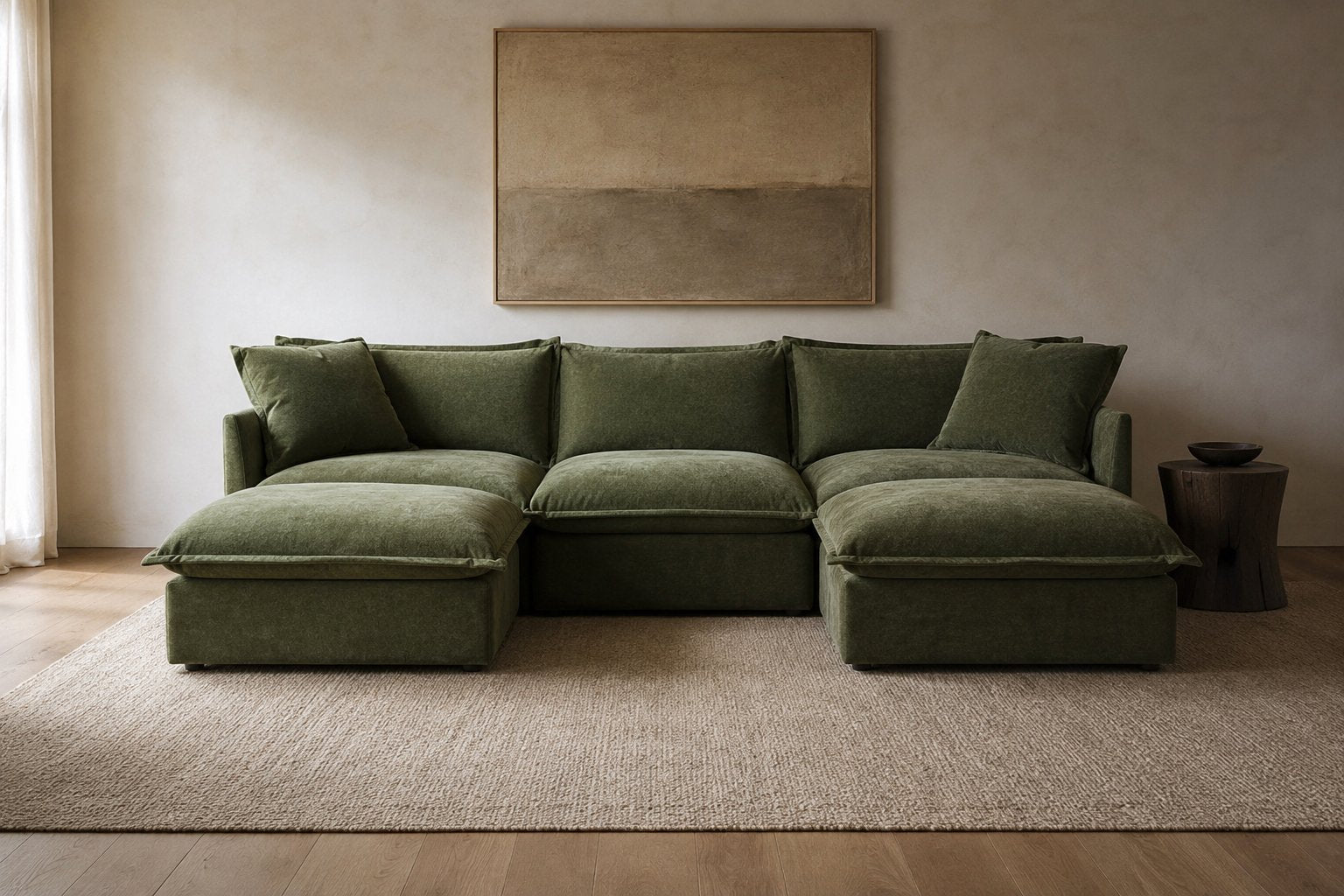

Article: What Is a Modular Sofa? How the Modules Fit Together

What Is a Modular Sofa? How the Modules Fit Together
A modular sofa is seating built from separate upholstered units, called modules, that sit together to form one sofa. Each module is a finished object with its own base, seat and back, so the shape is set by how you arrange them: a straight run, an L, a U, or pieces pulled apart into standalone chairs. A traditional sofa is a single fixed frame and its shape is decided at the factory. A modular sofa's shape is decided in your room, and you can change it later.
Modular, sectional and one-piece sofas are three different things
These words get used interchangeably and they should not be.
A one-piece sofa is a single frame. A sectional is two or more pieces that join into one fixed shape, usually a left-arm piece, a right-arm piece and sometimes a corner wedge or chaise. Those pieces are cut to fit each other and go together one way. A modular sofa uses repeating units that are interchangeable, so the same parts make several different layouts.
Here is the practical test. If the maker sells you a left side and a right side, it is a sectional. If it sells you a number of identical seats plus corner or arm pieces, it is modular. Plenty of products are genuinely both, which is why listings say "modular sectional". You can see where the lines fall by comparing our modular couches against the wider sectionals range.
Each module adds a fixed amount of width
This is the number that decides whether a modular sofa actually fits, and most buying guides skip it. Because the units repeat, length scales in even steps rather than smooth increments. On our machine washable modular line the step is 36.6 inches per added seat.
| Configuration | Overall length | Depth | Height | Added over previous |
|---|---|---|---|---|
| 2-seat loveseat | 83.4 in | 33 in | 34.6 in | n/a |
| 3-seat | 120 in | 33 in | 34.6 in | 36.6 in |
| 4-seat | 156.6 in | 33 in | 34.6 in | 36.6 in |
So if a 3-seat at 120 inches runs 14 inches wider than your wall allows, the 2-seat is not slightly smaller. It is 36.6 inches smaller, and there is nothing in between. That is the honest trade-off of modular construction: you gain layout freedom and you give up fine control over total length. Those figures come from the specifications on the 2-seat washable modular sofa, the 3-seat and the 4-seat.
"3-seat" tells you almost nothing about the size
Seat count is a comfort description, not a measurement. Modules differ in width, so two sofas that both seat three people can be nearly three feet apart in length. These are all 3-seat modular couches:
| Model | Width | Depth | Height | Weight |
|---|---|---|---|---|
| Green curved, deep seat | 87.4 in | 30.5 in | 27.3 in | 123.1 lbs |
| Gray corduroy, no assembly | 102.4 in | 35.5 in | 23.6 in | 120 lbs |
| Orange chenille curved | 116.1 in | 34.2 in | 36.2 in | 155.1 lbs |
| White corduroy, no assembly | 118.2 in | 39.4 in | 24 in | 151.5 lbs |
| Washable chenille or corduroy | 120 in | 33 in | 34.6 in | n/a |
That is a 32.6 inch spread in width and a 12.6 inch spread in height across five sofas with the same seat count. Height matters more than people expect, because a 23.6 inch back and a 36.2 inch back are different pieces of furniture: one disappears under a window, the other blocks it. Work from the published width, depth and height on the listing, not from the seat count in the title.
What is actually inside a modular sofa
Construction varies more in modular seating than in one-piece sofas, because a module does not always need a frame to hold its shape. Two real examples from our catalogue sit at opposite ends.
The green curved 3-seat at 87.4 inches is built with polyester upholstery over a solid wood frame. The white corduroy 3-seat at 118.2 inches is described by its manufacturer as having no wooden frame at all, with foam support throughout. Both are modular. They will not age the same way. A framed module holds a crisp edge longer; a foam-only module is lighter, more forgiving on stairs, and softer at the arms from the start.
Neither is automatically better, but the difference is worth knowing before you buy, and it is published in the specifications on each listing rather than something you have to guess from photographs.
One more thing worth knowing about the box. Cushions and pillows on several of these models are vacuum-compressed for shipping, and the makers state they need roughly 2 to 7 days after unpacking to return to full shape. A modular sofa that looks flat on day one is normal. Judge it at the end of that week.
Getting the modules through your door
This is the strongest practical argument for modular seating, and it is a measurement problem, not a marketing one.
Standard interior doors in US homes are commonly 32 inches wide, and front doors are typically 36 inches. A one-piece sofa 120 inches long has to pivot through those openings as a single rigid object, which is why long sofas get stuck on landings and in stairwells. A module roughly 36 inches wide and 33 inches deep goes through on edge, one trip at a time.
Weight follows the same logic. A 3-seat modular couch in our catalogue is listed at 120 pounds across its modules. A one-piece power reclining sofa of comparable width, 122 inches, is listed at 418.9 pounds. The modular one is not just lighter overall, it never has to be lifted all at once.
If your access is genuinely tight, measure the narrowest point on the route, not the room. Doorway, stair turn, elevator depth, whichever is worst. Then check it against module depth rather than overall sofa length.
Layouts a modular sofa can make
The point of modules is that one purchase covers more than one room arrangement. In practice there are four common moves:
- Straight run. All seats in a line against a wall. The least space-hungry option and the easiest to get wrong, because a straight run of four modules is over 13 feet long.
- L shape. Seats along one wall with two or three turning the corner. Suits open-plan rooms, where the return acts as a divider between seating and circulation.
- U shape. Seats on three sides around a coffee table. Needs real floor area, and it is worth checking against our U-shaped sectionals for what the footprint looks like at that size.
- Split. Two modules as a loveseat, one pulled out as a chair. This is the configuration people forget they bought, and it is the one that earns its keep when you rearrange or move.
In a smaller room, a 2-seat plus a separate module often works better than a fixed 3-seat, because you can push the single piece against a different wall. Our small sectionals are the narrower end of this if floor area is the binding constraint.
When a modular sofa is the wrong choice
Three cases, plainly.
If you need an exact length to fill an alcove or sit between two fixed pieces, modular construction fights you. Width comes in fixed steps, and the step on some lines is over three feet.
If you want a tailored, tight-upholstered look, modules tend to read softer and blockier because each unit has its own finished edges and the seams between them are visible. That is a style preference, not a fault, but it is visible in person.
If the sofa will sit in one place for a decade and never move, you are paying for flexibility you will not use. A one-piece frame in the same price range usually puts more of the cost into the frame.
Shipping and returns, stated plainly
Shipping to you is free. The washable modular line publishes a delivery window of 5 to 7 days, and the specifications on each listing state its own. Returns run 30 days, and return shipping is the customer's cost. For something the size of a sofa that is worth factoring in before you order, which is the real reason to measure first rather than plan on sending it back.
Frequently asked questions
Is a modular sofa the same thing as a sectional?
No, though the categories overlap. A sectional is two or more pieces shaped to join into one fixed layout, usually a left-arm piece and a right-arm piece that only fit one way. A modular sofa uses interchangeable repeating units, so the same parts make a straight run, an L or separate chairs. Many products are sold as modular sectionals because they do both.
How much width does each extra module add?
It is fixed per model, and it is larger than most people expect. On our machine washable modular line the 2-seat is 83.4 inches long, the 3-seat is 120 inches and the 4-seat is 156.6 inches, so every added seat adds 36.6 inches. There is no size in between, so measure your wall before you choose a seat count.
Do modular sofas need assembly?
It depends on the model, and assembly is published in the specifications on each listing. Some arrive ready to use, such as the gray corduroy 3-seat at 102.4 inches wide, which is listed as needing no assembly. Others require joining the modules or fitting legs. Modular construction usually means fewer tools than a one-piece frame, because the work is connecting finished units rather than building a frame.
Are modular sofas easier to move than a one-piece sofa?
Usually yes, because the weight splits across pieces and each piece is smaller than the whole. A 3-seat modular couch in our catalogue is listed at 120 pounds in total, while a one-piece power reclining sofa of comparable width is listed at 418.9 pounds. The bigger advantage shows on stairs and corners, where a single long frame cannot pivot and a module can.
Can you buy extra modules later to make it bigger?
Sometimes, and you should not assume it. Whether single modules are sold separately varies by model, and a matching fabric and dye lot will not be available indefinitely. If growing the sofa later matters to you, check the configuration you want on the listing before buying the smaller one, and treat a later match as a possibility rather than a plan.
Does a modular sofa have a wooden frame?
Not always, and it is worth checking. Construction is published in the specifications on each listing. Some modular sofas are built on a solid wood frame, such as the green curved 3-seat at 87.4 inches wide, which lists polyester upholstery over solid wood. Others are foam-only: the white corduroy 3-seat at 118.2 inches wide is described by its manufacturer as having no wooden frame, with foam support throughout. Foam-only modules are lighter and easier to move. A framed module holds its edge shape longer.
Sources and method
Dimensions, weights, fills, assembly notes and delivery windows in this article come from the specification records on the listings on this site, which are supplied by the manufacturers and recorded from their written specifications. They are not our own measurements, and specifications can be revised, so the listing is the authority at the time you order. Where a figure is not published for a model, it is marked n/a above rather than estimated.
Standard US door widths are from Bob Vila's guide to standard door sizes. Those are common sizes in new construction, not a guarantee about any particular house, which is why measuring your own route matters more than the standard.